Blackjack
Duel's blackjack is built to take nothing from a player who plays it correctly. Its revenue comes from the gap between how the game should be played and how it actually is — which makes it the only casino game where studying genuinely changes what you pay.
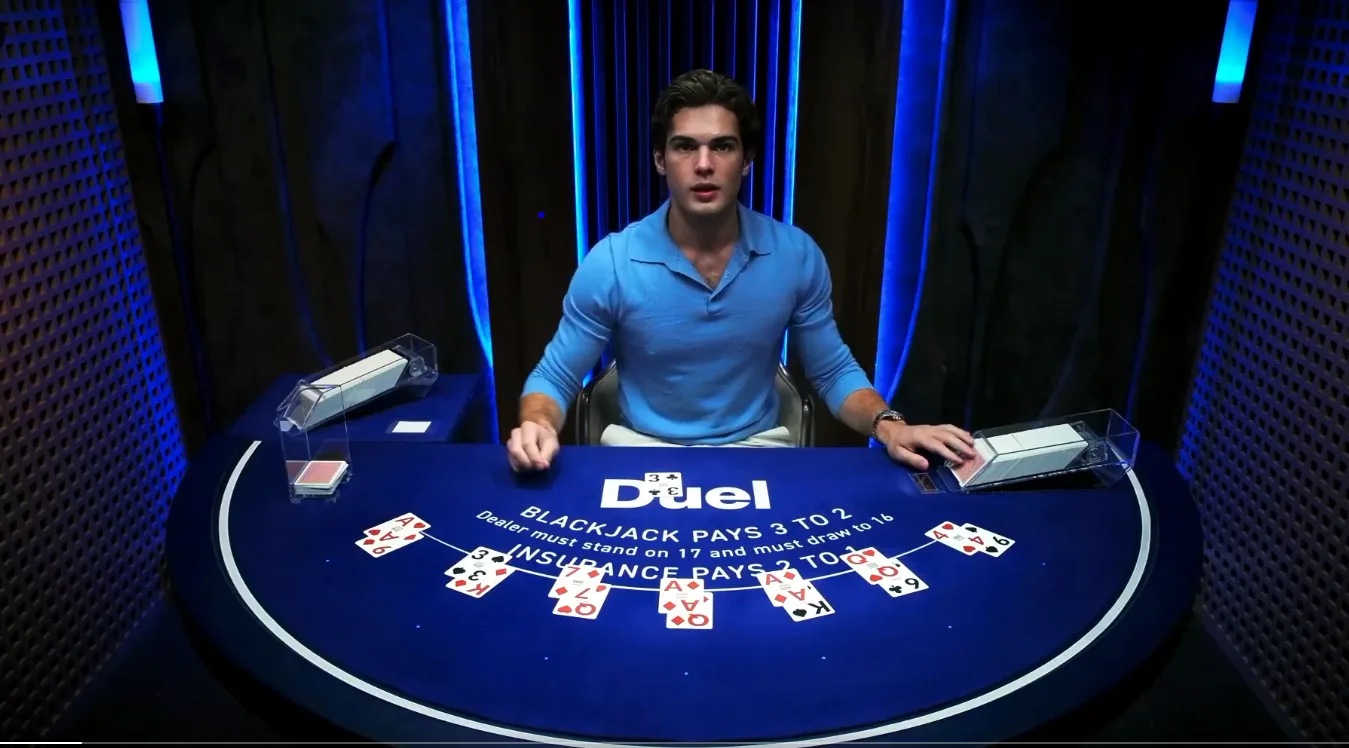

An unusual arrangement
Standard blackjack carries a small built-in edge — around half a percent against a player using perfect basic strategy, depending on the rule set. It is not much, but it is unavoidable: play flawlessly forever and you still lose slowly.
Duel states that its blackjack has no house edge under perfect play. If that holds, the game is not built to profit from correct decisions at all. What it profits from is everything else — and almost nobody plays a full session without a single deviation.
This inverts the usual relationship. At most tables, studying reduces a loss you cannot escape. Here, studying is the entire difference between paying nothing and paying a great deal, and the size of that gap is under your control rather than the operator's.
What each mistake costs
These are the standard expected-value differences for the common errors. Read each as the share of your bet that the decision gives away, every time you make it.
| Mistake | Cost per bet | |
|---|---|---|
| Not splitting A,A | 38.0% | The single most expensive mistake available |
| Hitting 11 vs 10 instead of doubling | 18.0% | Passing up the best doubling spot in the game |
| Not splitting 8,8 vs 10 | 10.0% | Two bad hands beat one worse one |
| Taking insurance | 7.5% | A side bet with its own edge, always |
| Standing A,7 vs 9 | 7.0% | Soft 18 is not a made hand against a nine |
| Splitting 9,9 vs 7 | 4.0% | Eighteen already beats the dealer's likely seventeen |
| Standing 16 vs 10 | 3.8% | The most commonly played wrong hand in blackjack |
| Standing 12 vs 2 | 1.7% | Feels safe, is not |
Splitting aces is the one that should stop people. Failing to split them costs 38% of the bet — nearly four hundred times the house edge on Duel Dice, in a single decision, on a hand that arrives roughly once every two hundred and twenty.
Turning errors into an edge figure
Individual mistakes are easier to understand as a rate. If the average deviation costs around 5% of a bet, then your personal house edge is simply your error rate multiplied by that.
| Errors per 100 hands | Your effective house edge | Comparable to |
|---|---|---|
| 0 | 0.00% | Nothing on the market |
| 1 | 0.05% | Better than Duel Dice |
| 2 | 0.10% | Duel Dice |
| 5 | 0.25% | Very good blackjack elsewhere |
| 10 | 0.50% | Standard six-deck, played perfectly |
| 20 | 1.00% | A typical crypto casino house game |
Twenty errors in a hundred hands sounds careless and is roughly where a casual player sits — most people make more mistakes than they think, and the expensive ones cluster in exactly the spots that feel obvious.
The three that account for most of it
16 against a ten. The most misplayed hand in blackjack. Hitting loses often and feels wrong; standing loses more. It is a choice between two bad outcomes and the counter-intuitive one is correct.
Insurance. Marketed as protection, priced as a side bet with its own edge. It is never correct without card counting, and taking it costs 7.5% of the insurance stake every time.
Splitting. Aces and eights always split; tens and fives never. Those four rules alone remove a large share of what most players give away, and they take about a minute to memorise.
Why the table exists at all
A game with no edge under correct play still needs to be survivable for the operator, and blackjack solves that differently from the other Originals. Where a zero-edge Dice or Limbo round needs caps to contain the variance, blackjack is protected by something more reliable: the certainty that a proportion of players will hit on a hard 17 at some point in the evening.
That is not a criticism. It is stated openly, it is checkable, and it is a considerably more honest arrangement than a table that takes half a percent from everyone regardless of how well they play.
What to do about it
Learn basic strategy properly rather than approximately. It is a fixed table of correct decisions for every combination of your hand and the dealer's upcard, it does not change between sessions, and it is the only "system" in gambling that actually works — because it is not a system, it is the solution.
Then play at a pace that lets you use it. Live tables move quickly and the expensive mistakes are the rushed ones.
Sessions from this table, including the Tyson appearance, are in the video archive.
The only game you can play to zero
Correct decisions cost you nothing here. Everything else is a choice you are making.
Play at Duel