Dice, measured
Dice is the one casino game where you can read the house edge straight off the screen. Two numbers are printed in the interface, and multiplying them tells you exactly what the game costs. Almost nobody does it.
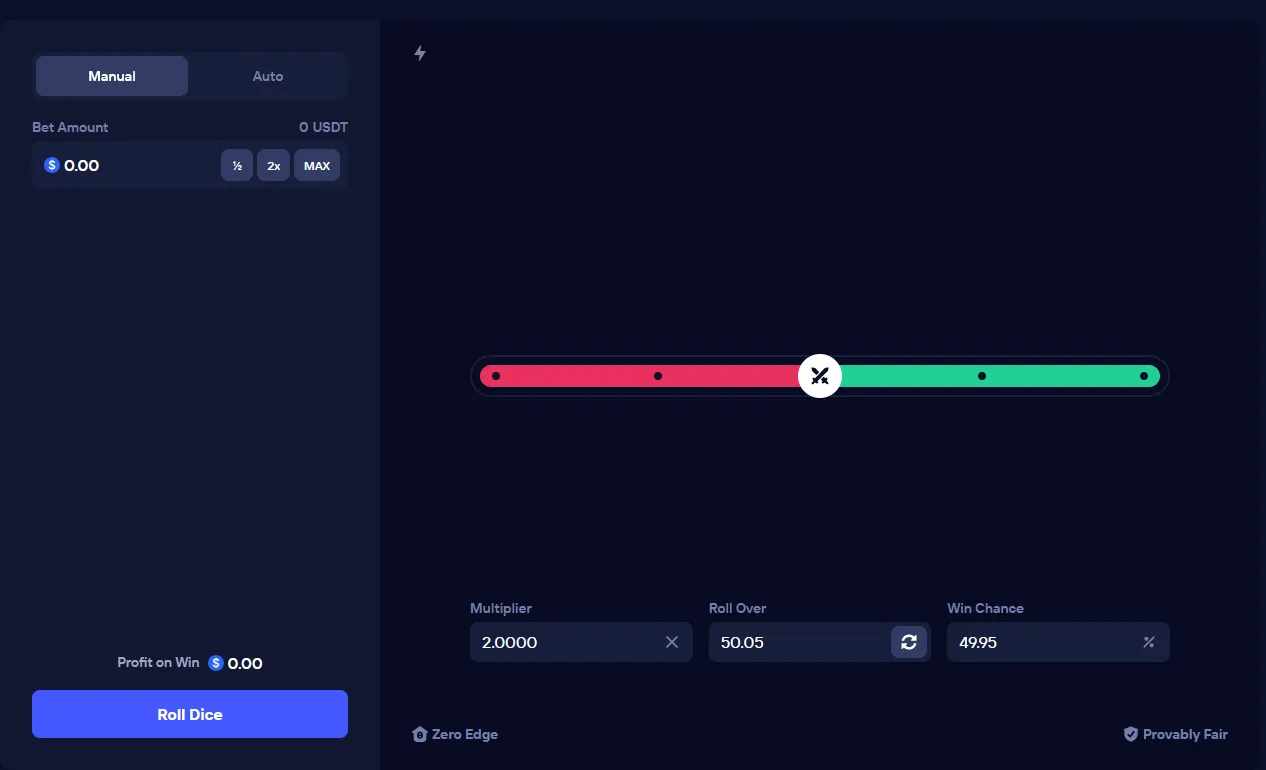
The calculation
At default settings the interface reads a win chance of 49.95% and a multiplier of 2.0000×. Expected return per unit staked is simply one multiplied by the other:
0.4995 × 2.0000 = 0.9990
RTP 99.90% · house edge 0.10%
That is the whole game. No hidden weighting, no bonus round burying the maths, no provider specification to take on trust. Two printed numbers and one multiplication.
Why 0.05 of a percent is the entire story
A fair coin flip paying 2× would need a win chance of exactly 50.00%. The interface shows 49.95%. That missing five hundredths of a percentage point is the house edge, and it is the only thing standing between this game and a break-even proposition.
Now compare. The widespread setup elsewhere in crypto casinos is a 49.5% win chance at the same 2× multiplier:
| Setup | Win chance | RTP | House edge |
|---|---|---|---|
| A true coin flip | 50.00% | 100.00% | 0.00% |
| Duel Dice | 49.95% | 99.90% | 0.10% |
| Common competitor setup | 49.50% | 99.00% | 1.00% |
The edge is ten times smaller. Half a percentage point of win chance sounds like rounding; over a playing career it is the difference between a hobby that bleeds and one that mostly holds its level. We put numbers on that in the RTP simulation — at 99% RTP roughly one player in a thousand finishes ahead over a hundred thousand bets, at 99.9% it is more than a third.
About the badge
The game carries a "Zero Edge" badge and the lobby lists every Original at 100% RTP. The interface computes to 99.90%. Those are not in conflict as much as they look: Duel's own game artwork labels Dice at 99.9%, and its FAQ says the platform currently stands at 99.9% while aiming for 100%.
So the 100% in the lobby is rounding, and 99.9% is the working figure — which is exactly what the two numbers on this screen multiply out to. Three independent places now say the same thing, and one of them is the game itself.
Check it yourself in about ten seconds: open Dice, read the win chance and the multiplier, multiply them. Whatever the badge says, that product is your actual return.
Moving the slider
Dice lets you trade probability against payout — a lower win chance buys a bigger multiplier. What does not change is the relationship between them: the edge is built into the ratio, so it stays roughly constant wherever you set the slider.
This is worth internalising because it kills the most common dice strategy. Betting a 1.01× at a 98% win chance feels safe and costs the same proportion of turnover as chasing a 10×. Setting the slider does not change what you pay. It changes how the losses arrive — rarely and large, or often and small.
Verification
Each roll can be checked against its seeds after the fact, using the same commitment scheme as the rest of the Originals. There is a working verifier on the provably fair page — paste the revealed server seed and compare the hash to the one published before you played.
Between that and the multiplication above, Dice is the most completely checkable game on the site: you can verify both that the odds are what they claim and that the outcome was not tampered with.
Read the two numbers
Win chance times multiplier. That product is the game, and it is printed on screen.
Play at Duel