Mines, by the numbers
Mines looks like a nerve game and is actually a closed maths problem. Every multiplier in it can be derived from two numbers — how many mines are on the grid and how many tiles you have already survived.
The one formula
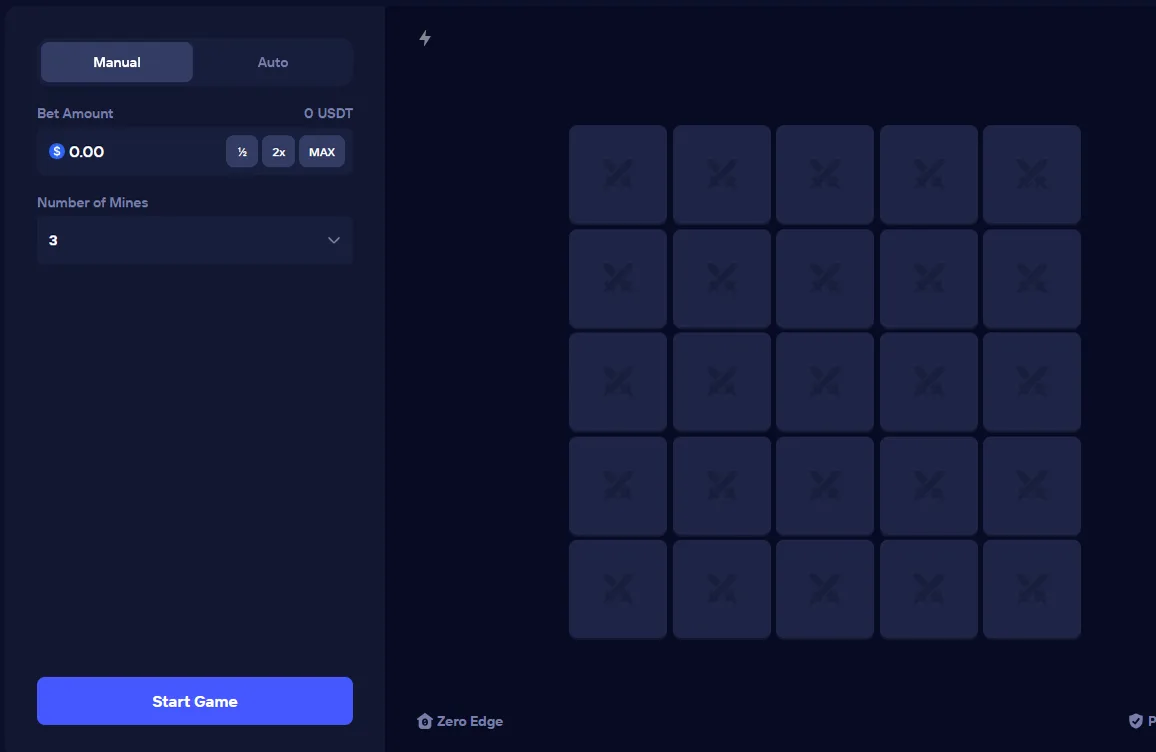
A grid holds 25 tiles. Put m mines on it and 25 − m are safe. The chance of clicking k safe tiles in a row is the number of ways to choose k tiles from the safe ones, divided by the ways to choose k from all of them:
P(survive k) = C(25−m, k) ÷ C(25, k)
The fair multiplier — what a payout would be if the game took nothing at all — is simply 1 ÷ P.
That is the whole game. There is no pattern to read, no hot tile, no due square. Each round is a fresh shuffle, so nothing that happened in the last round changes anything in this one.
Three mines, every step
Three is the setting most people play, so here is the full curve for it. Read the last column as the ceiling: no honest game pays more than this.
| Tiles cleared | Chance of getting here | Fair multiplier |
|---|---|---|
| 1 | 88.0000% | 1.1364× |
| 2 | 77.0000% | 1.2987× |
| 3 | 66.9565% | 1.4935× |
| 4 | 57.8261% | 1.7293× |
| 5 | 49.5652% | 2.0175× |
| 6 | 42.1304% | 2.3736× |
| 7 | 35.4783% | 2.8186× |
| 8 | 29.5652% | 3.3824× |
| 9 | 24.3478% | 4.1071× |
| 10 | 19.7826% | 5.0549× |
| 12 | 12.4348% | 8.0420× |
| 15 | 5.2174% | 19.1667× |
| 18 | 1.5217% | 65.7143× |
| 20 | 0.4348% | 230.0000× |
| 22 | 0.0435% | 2,300.0000× |
Notice how slowly it moves at the start. Clearing three tiles out of 25 with three mines buried pays under 1.5× because you were always likely to manage it — about a two-in-three shot. The interesting money only starts once the probability drops under 10%, and by then you are betting on a one-in-ten outcome.
How the mine count changes everything
| Mines | Cleared | Chance | Fair multiplier |
|---|---|---|---|
| 1 | 1 | 96.0000% | 1.0417× |
| 3 | 88.0000% | 1.1364× | |
| 5 | 80.0000% | 1.2500× | |
| 10 | 60.0000% | 1.6667× | |
| 3 | 1 | 88.0000% | 1.1364× |
| 3 | 66.9565% | 1.4935× | |
| 5 | 49.5652% | 2.0175× | |
| 10 | 19.7826% | 5.0549× | |
| 5 | 1 | 80.0000% | 1.2500× |
| 3 | 49.5652% | 2.0175× | |
| 5 | 29.1813% | 3.4269× | |
| 10 | 5.6522% | 17.6923× | |
| 10 | 1 | 60.0000% | 1.6667× |
| 3 | 19.7826% | 5.0549× | |
| 5 | 5.6522% | 17.6923× | |
| 10 | 0.0919% | 1,088.4982× |
Ten mines and ten tiles cleared is a 0.09% event — roughly one round in a thousand. That is where the four-figure multipliers live, and it is worth seeing the number written out before chasing one.
Reading the table against a real game
The numbers above are the zero-edge case — what a game pays if it keeps nothing. Most versions of Mines you will meet pay somewhat less than this, and the gap is the margin. If a game offers 4.80× where the fair figure is 5.0549×, it is keeping about 5%, and it keeps it on every cashout rather than occasionally.
That makes this table a measuring instrument. Set the same mine count, clear the same number of tiles, and compare what appears on screen against the column above. The ratio is the house edge, to as many decimal places as you care to take it — no published figure required, no operator to trust.
Duel's version carries a 100% RTP badge, which means the payouts should match the fair column rather than sit under it. That is a claim you can check in about thirty seconds using this table, which is the point of publishing it.
Caps apply — a zero-edge game cannot be offered without them, for reasons covered here.
One thing the mine count does not change: at a fixed edge, fewer mines does not mean better value. It means smaller multipliers for the same proportional cut. What changes your position is the edge itself, not the configuration.
The one decision that matters
Since the maths is fixed, the only real choice in Mines is when to stop. A cashout target set before the round starts is a plan. A cashout decided while watching the multiplier climb is not — that is the part of the game that is designed to be difficult, and it is the only part the design can actually influence.
Every round can also be checked after the fact against its seeds. That is covered on the provably fair page.
Check the numbers yourself
Set three mines, clear five tiles, and compare what the game offers against 2.0175×. Any shortfall is the house edge. There should not be one.
Play at Duel