Mike Tyson
at the Duel table
Duel put the heavyweight champion on its live blackjack table for a session in June. He played real hands against a real dealer with the chat running alongside — and at one point nearly handed the whole table a free win.
The clips
 0:10
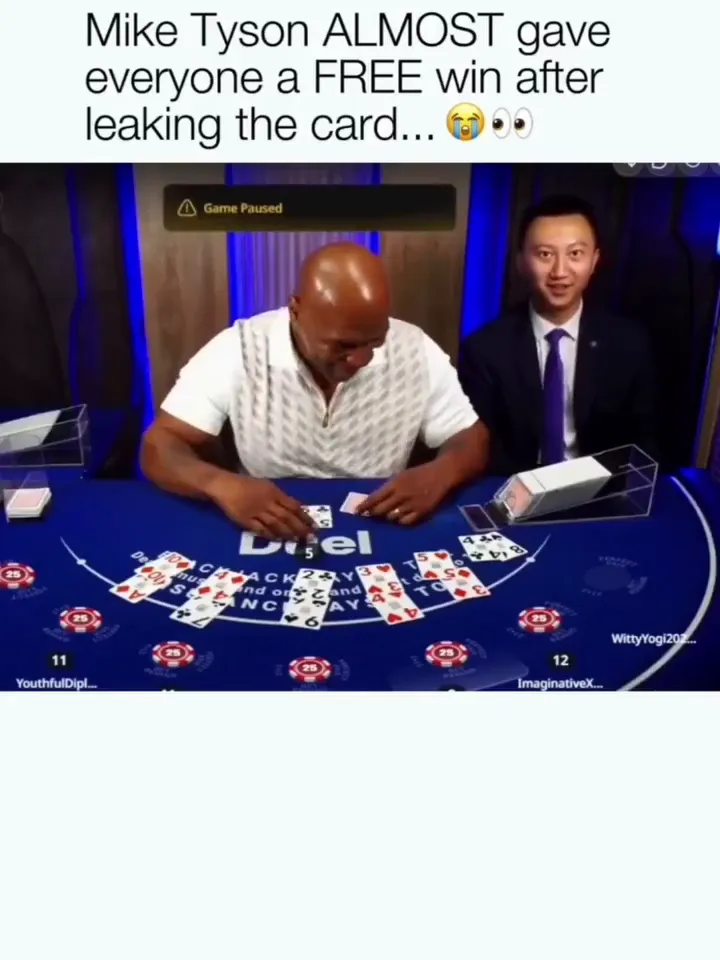
0:10The card leak
Tyson lifts his hand a little too far and the table gets a look.
 0:12
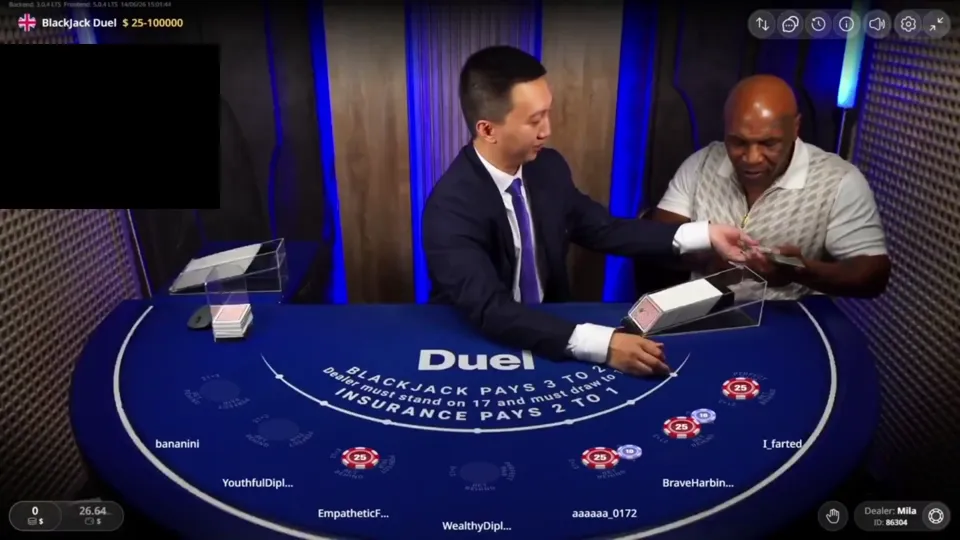
0:12At the table
15:01:43 on the $25–100000 table, dealer Mila.
 0:22
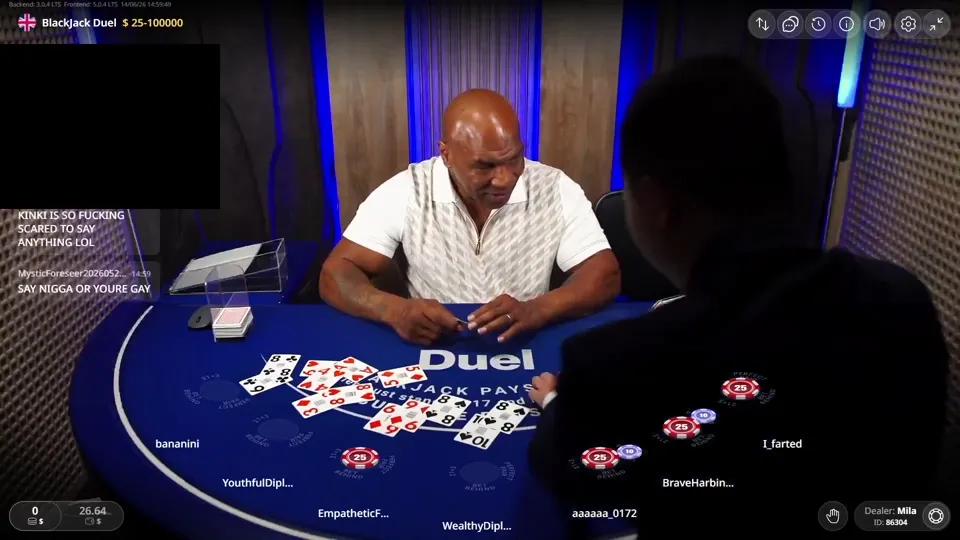
0:22Head in hands
14:59:42, the earliest capture we have from this broadcast.
 0:15
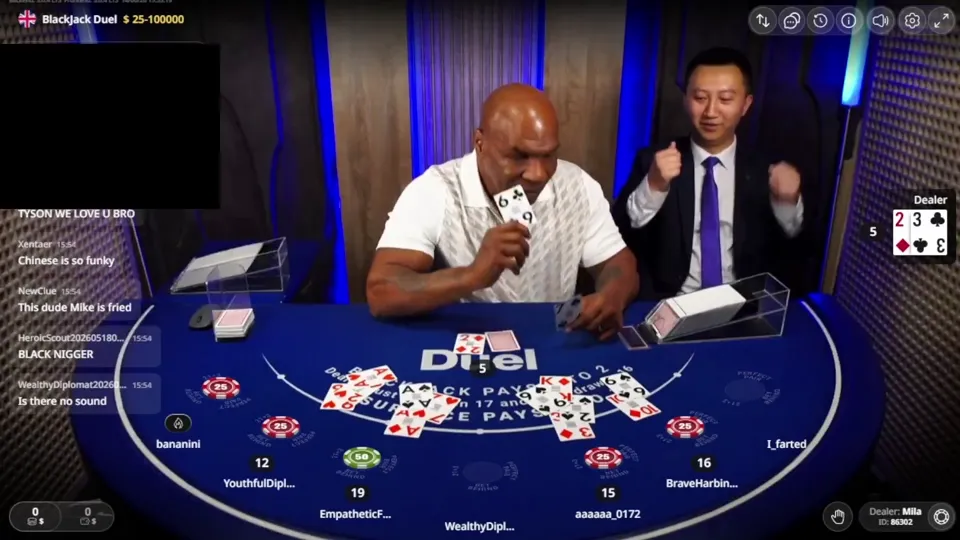
0:15Later in the session
Same broadcast, same dealer, shift ID 86302.
What the recordings themselves say
Duel's live client prints a developer bar across the top of the broadcast, and it survives into every capture. It carries the build numbers and the broadcast date to the second. A header strip underneath names the table and its limits; a badge in the bottom-right gives the dealer's first name and a shift ID.
Read off our recordings frame by frame rather than from file names:
| Clip | Broadcast time | Table | Dealer (shift ID) | Runtime |
|---|---|---|---|---|
| At the table | 14/06/26 15:01:43 | $25–100000 | Mila (86304) | 12.1s |
| Head in hands | 14/06/26 14:59:42 | $25–100000 | Mila (86304) | 22.3s |
| Later in the session | 14/06/26, partly legible | $25–100000 | Mila (86302) | 15.2s |
| Bonnie Blue slot, for comparison | 03/06/26 15:36:59 | $25–100000 | Mila (75004) | 16.0s |
| The card leak | not in frame | not in frame | not in frame | 9.8s |
Build strings on all three: backend 3.0.4 LTS, frontend 5.0.4 LTS. Where the capture is cropped past an overlay the field is left empty rather than filled with a guess.
So this was a single continuous broadcast on the high-limit table on 14 June 2026, with Mila dealing throughout. The two clearest captures sit two minutes apart.
What the shift ID actually tracks
The obvious reading of a five-digit number that climbs is a counter. Other archives of Duel clips have concluded exactly that and put the rate at forty-odd ticks an hour, which is roughly how long a live blackjack round takes.
Over a long baseline that holds up well. A clip from 3 June on this same table, same dealer, reads ID 75004. Eleven days later these captures read 86304. That is 11,300 steps across 11 days — about 1,027 a day, or roughly 43 an hour on a table running around the clock. It lands almost exactly where the round-counter estimate predicts.
Within a single afternoon it does not behave. Two of our clips 121 seconds apart carry the same ID, 86304, where a per-round counter should have advanced. A third, later in the same broadcast, reads 86302 — lower.
Lined up against the two publicly logged 14 June clips at 15:25:40 (86318) and 16:53:00 (86302), the afternoon runs 86304, 86304, 86318, 86302, 86302. It holds, climbs, then falls back.
So the rate estimate survives and the ordering does not. Something resets the counter between stretches of play — a shoe change, a table restart, a shift handover out of shot. The practical consequence is the useful part: the ID is a reasonable rough clock across days and useless for putting clips from one afternoon in order.
The clip that travelled furthest
The card leak. Tyson lifts his hole card to check it and takes it high enough that the camera, and by extension everyone watching, gets a look before he does. In a live game with an audience, that is information nobody is supposed to have.
Why the leak matters more than it looks
In blackjack you are not playing against the other people at the table — everyone plays their own hand against the dealer. So a leaked card does not cost the player who leaked it anything directly, which is why the moment plays as comedy rather than disaster.
What it does is hand information to everyone watching. Knowing a card that has left the shoe shifts the composition of what is left, and card composition is the entire basis of advantage play. One card seen once is worth close to nothing. The principle behind it is worth quite a lot, and it is the reason casinos take card exposure seriously.
Duel's blackjack carries no house edge under perfect basic strategy — its revenue on the game comes from players deviating from correct play. Which makes a table where cards occasionally get flashed a slightly stranger proposition than usual.
Why Duel does this at all
Duel markets through spectacle rather than banner advertising. A recognisable face at the table produces clips that travel on their own, and each one carries the table layout and the logo with it. This session is the model working exactly as intended: the moment was clipped, reposted and captioned by people who were not watching the stream, and it brought them here.
The same approach runs through the rest of the studio output and, at a larger scale, into the fight promotion Duel now runs.
On the chat, and what we did with it
Duel's broadcast runs an open chat panel down the left of the frame, unmoderated in practice. On this session it carries racist usernames and messages, so the clips here have that panel masked out before publishing.
Masked rather than cropped, deliberately: cropping the left edge would also remove the developer bar, and with it the broadcast timestamps that make the table above possible. The game, the felt, the dealer badge and the timing data are all intact — only the chat column is covered.
The table itself
The blackjack Tyson played is Duel's own live game, not a third-party supplier's. That matters for one specific reason: the rules and the maths are Duel's to set, and they have set them at no edge under perfect play. What the game actually returns therefore depends on how well it is played, which is unusual enough to be worth learning properly.
Related: how a zero-edge game stays solvent and the rest of the clip archive.
Same table, any time
The table from these clips runs around the clock, with rakeback on every hand.
Play at Duel