Plinko, counted
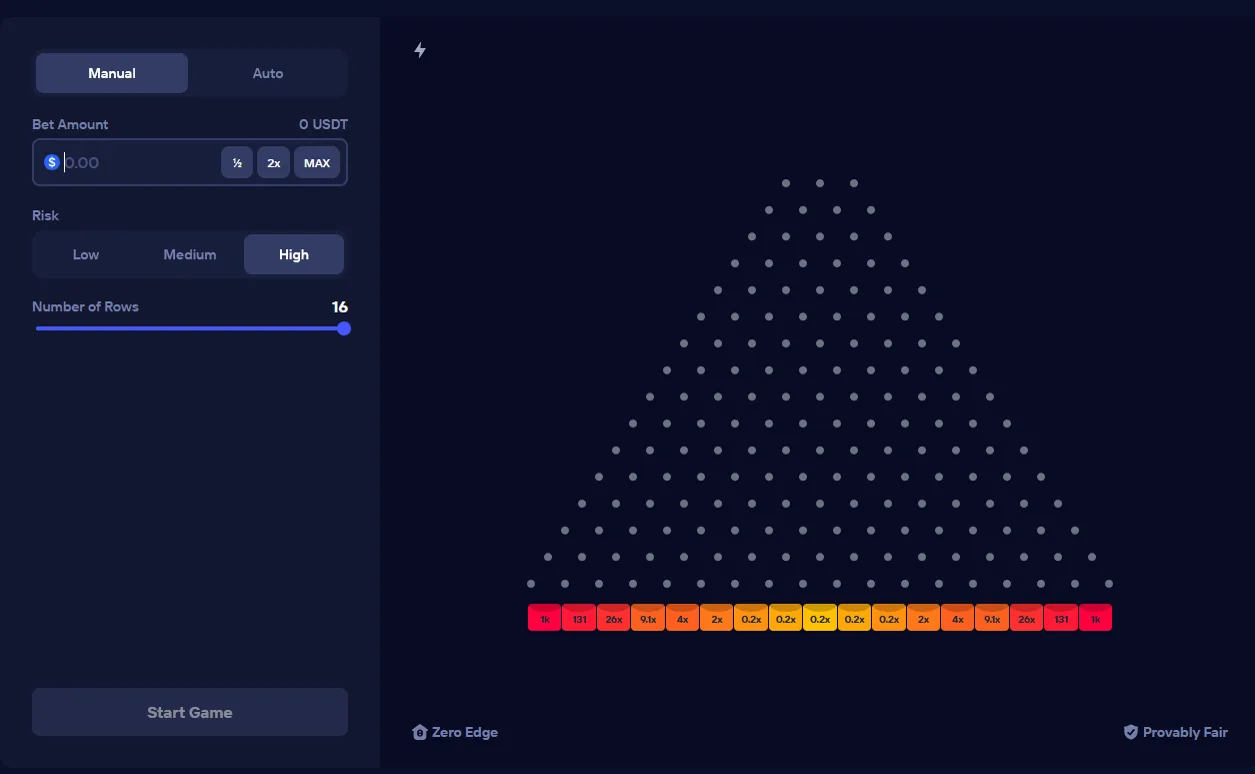
A ball falls through sixteen rows of pegs and lands in one of seventeen buckets. Which bucket is not mysterious — it is a coin flip repeated sixteen times, and that makes the whole game computable.
Why it is a binomial distribution
At every peg the ball goes left or right. Sixteen rows means sixteen such decisions, and the bucket it lands in is decided by how many of them went right. That is textbook binomial: the chance of landing in bucket k is C(16, k) divided by 216.
Two consequences follow immediately. There are 65,536 possible paths through the board. And the middle buckets are reached by vastly more of those paths than the edges — which is why the middle pays least.
The distribution
| Bucket | Chance | Multiplier | Contribution to RTP |
|---|---|---|---|
| 0 | 0.00153% | 1000× | 0.01530 |
| 1 | 0.02441% | 131× | 0.03198 |
| 2 | 0.18311% | 26× | 0.04761 |
| 3 | 0.85449% | 9.1× | 0.07776 |
| 4 | 2.77710% | 4× | 0.11108 |
| 5 | 6.66504% | 2× | 0.13330 |
| 6 | 12.21924% | 0.2× | 0.02444 |
| 7 | 17.45605% | 0.2× | 0.03491 |
| 8 | 19.63806% | 0.2× | 0.03928 |
Buckets 9 to 16 mirror 7 down to 0 exactly — the board is symmetrical.
What it adds up to
Summing every bucket: RTP ≈ 99.20%, house edge ≈ 0.80%.
Approximate on purpose. The interface rounds its display values — 9.1×, 0.2×, 1k — so the true multipliers carry more decimal places than we can read. The figure moves a little either way depending on what those digits are.
The two numbers worth knowing
Roughly 79% of drops land in a 0.2× bucket. Four times out of five you get back a fifth of your stake. That is not a bad run — that is the design, and it is what funds the edge multipliers.
A 1000× bucket is one drop in 32,768. At one drop every three seconds that is about twenty-seven hours of continuous play for an even chance of seeing one. The number on the screen is real; the frequency is the part people misjudge.
This is what high risk means in practice, and it is worth saying plainly because the board makes it look like the ball could go anywhere. It could. It just overwhelmingly does not.
Risk levels
Low, medium and high change the shape of the payout table rather than the return. Low risk flattens it — the middle pays closer to 1× and the edges pay far less. High risk does what you see above: near-worthless middle, spectacular edges.
The house edge stays broadly the same across all three. What changes is variance, which is a decision about how you want to lose rather than how much.
How this compares
Roughly 0.8% is a low edge for Plinko — the game is usually built with more margin than this. It is still eight times what Dice charges at 0.10%, which is worth knowing if you care about the number rather than the spectacle.
Every drop is checkable after the fact with the seed verifier, and what a fraction of a percent does over a career is in the ruin table.
The middle is where the ball goes
Four drops in five return 0.2×. Worth knowing before the fifth.
Play at Duel