Limbo
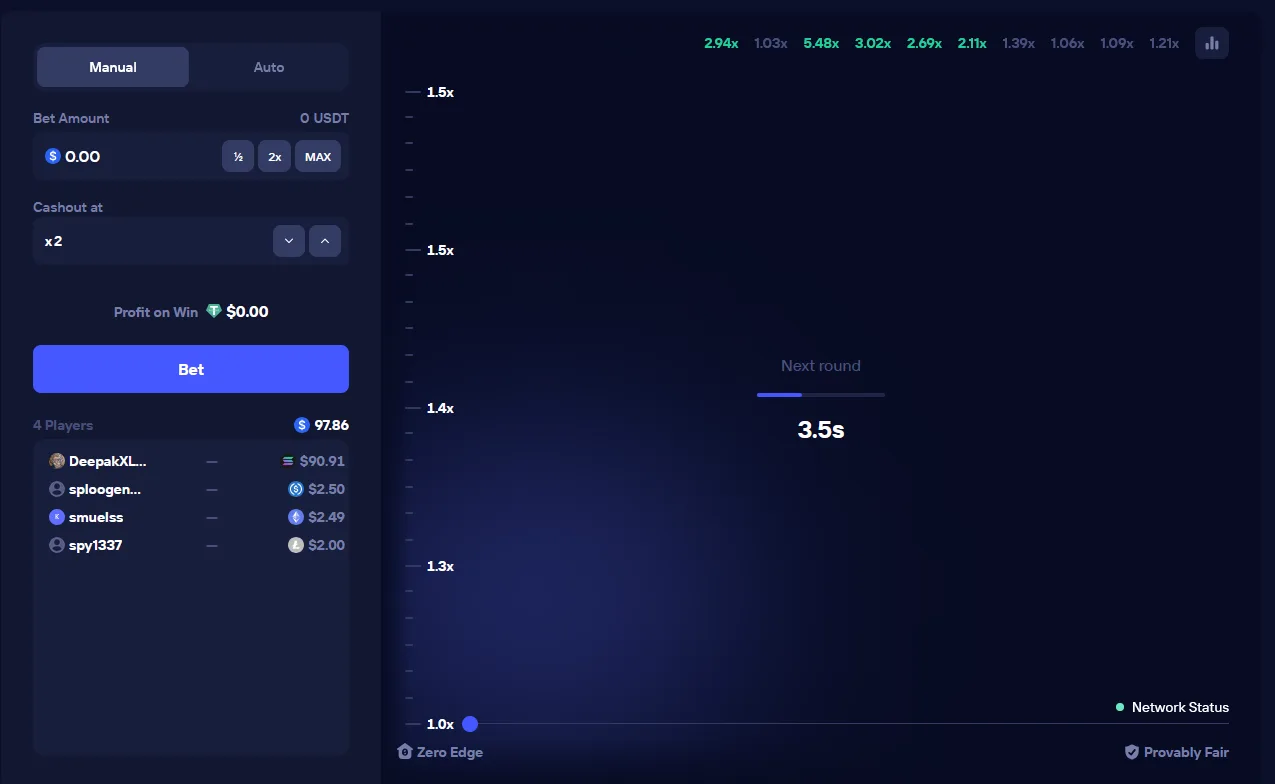
Limbo is the simplest game in the building and the easiest to audit. You set a target multiplier, the round produces a number, and you win if the number reaches your target. One input, one fair answer.
The rule
Fair win chance = 1 ÷ target multiplier
Nothing else is defensible. If a 10× target wins less often than one time in ten, the shortfall is the house edge, and it is measurable to as many decimals as you care to take.
The reasoning is one line. If you stake 1 unit at a target of M, a win returns M. For expected value to be zero, the probability of winning must be exactly 1/M — otherwise the game is either giving money away or taking it.
The table
| Target | Fair win chance | At 99% RTP | One win in |
|---|---|---|---|
| 1.5× | 66.6667% | 66.0000% | 1 rounds |
| 2.0× | 50.0000% | 49.5000% | 2 rounds |
| 3.0× | 33.3333% | 33.0000% | 3 rounds |
| 5.0× | 20.0000% | 19.8000% | 5 rounds |
| 10× | 10.0000% | 9.9000% | 10 rounds |
| 25× | 4.0000% | 3.9600% | 25 rounds |
| 100× | 1.0000% | 0.9900% | 100 rounds |
| 1,000× | 0.1000% | 0.0990% | 1,000 rounds |
The last column is the one people misjudge. A 100× target is not rare in the way "big win" implies — it is one round in a hundred, which sounds reachable and is, on average, after a hundred losses. A 1000× target is one round in a thousand.
Checking it in about a minute
Set a target. Read the win chance the interface gives you. Multiply the two together. On a zero-edge game that product should come out at 1.0000 — a 10× target at exactly 10.0000%, a 2× at exactly 50.0000%.
Anything below 1.0000 is the margin. At a 99% return a 10× target would show 9.9000% instead of 10.0000%, which looks like a rounding artefact and is a full percent of every bet you ever place.
This is the same arithmetic that makes Dice auditable, and for the same reason: both games print their own odds.
Why the target choice does not help you
Since the edge lives in the ratio between win chance and payout, it stays constant wherever you set the target. A 1.5× at a 66% win chance costs the same proportion of turnover as a 1000× at 0.1%.
What changes is the shape. Low targets lose slowly and often feel like they are working. High targets lose fast with a lottery attached. Neither is cheaper. Choosing a target is a decision about variance, not about value — and the same is true of the slider in Dice and the risk setting in Plinko.
Verification
Every round is checkable against its seeds afterwards using the verifier. Between that and the one-line arithmetic above, Limbo is fully auditable: you can confirm the odds are honest and that the result was not altered after you bet.
One division, one answer
Target times win chance should equal 1.0000. Check it before you set a target.
Play at Duel