Crash
A multiplier climbs from 1× and stops at a random point. Cash out before it stops and you keep the multiplier; be a fraction late and you keep nothing. One decision per round, and it is the hardest decision in gambling.
The structure
A fair crash game has one defining property: the chance of reaching a multiplier of M is 1/M. Reaching 2× happens half the time, 10× one time in ten, 100× one round in a hundred. An auto-cashout set at M therefore wins 1/M of the time and pays M, which is exactly break even.
Chance of reaching M = 1 ÷ M. The same rule that governs Limbo, because underneath the animation they are the same game — one shows the number climbing, the other asks you to name it in advance.
House edge, where a game has one, is applied by shaving that probability slightly: a 1% edge means reaching 2× happens 49.5% of the time rather than 50%. Small enough to be invisible in a session, decisive over a career — the effect is quantified in our RTP simulation.
The memoryless property
This is where most crash strategies die. The multiplier's stopping point is drawn fresh each round, so a run of low crashes tells you nothing about the next one. There is no pressure building, nothing "due", no correction coming.
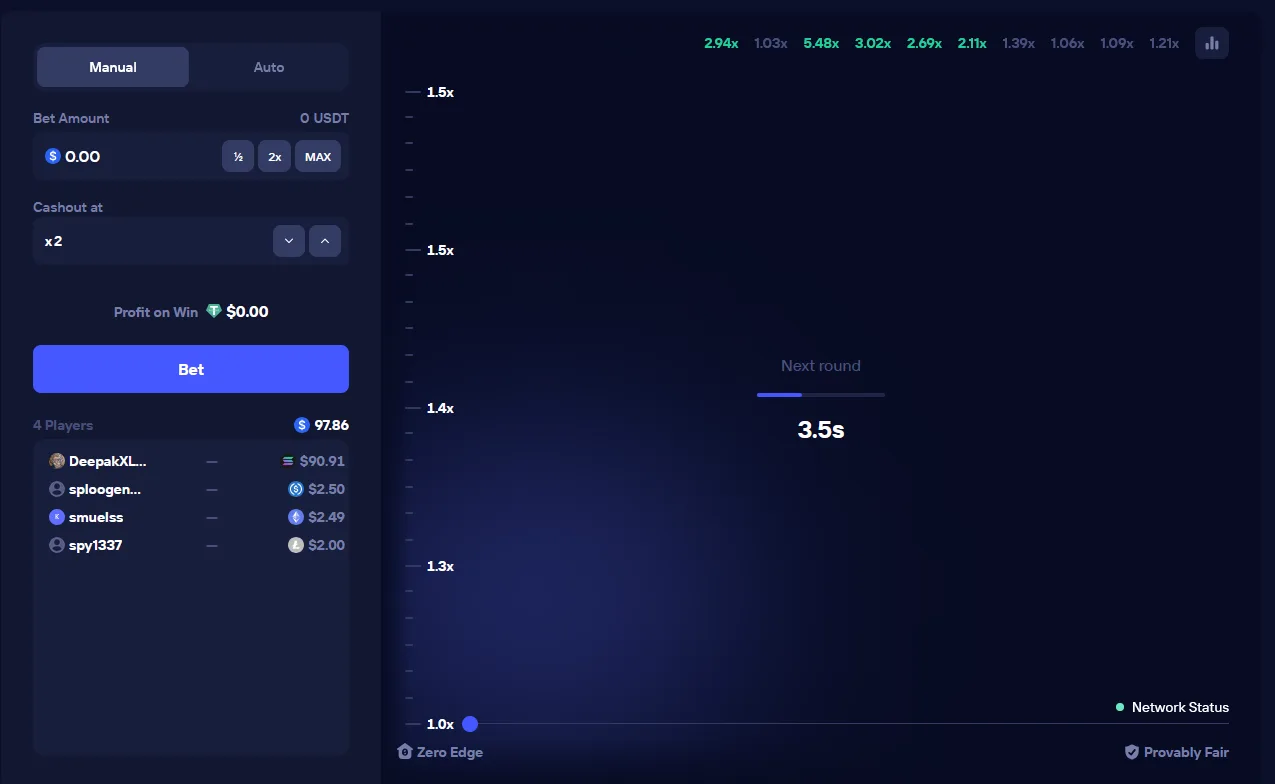
Which makes the round history strip along the top of the screen the most misleading element in the interface. It is real data about rounds that are over and have no bearing on the round about to start. It exists because people want to see it, and wanting to see it is the reason it works as a design.
Why no cashout strategy wins
Every crash system reduces to picking a target and a stake pattern, and neither changes the expectation.
Low targets — cashing at 1.2× wins about 83% of the time and feels like a system. The 17% of rounds you lose take back more than the wins bring in, exactly.
High targets — cashing at 50× wins 2% of the time and pays 50×. Same expectation, wildly different experience.
Martingale — doubling after a loss converts many small wins into one catastrophic loss. The expectation is unchanged; the distribution is reshaped into something that looks like it is working right up until it is not.
What does differ is the manual cashout. Auto-cashout executes at your target exactly. Manual introduces reaction time, and reaction time under pressure is worse than you think. The game's only real skill component is the discipline to not use it.
The live bet list is real
The player names and stakes down the left side of the screen are actual bets from actual accounts. Duel states that every wager on the platform is real money at one to one, with no sponsored balances and no arrangements that change the amount at risk.
That matters more in crash than almost anywhere else, because crash is a shared round: everyone watches the same multiplier and sees who held on. A feed padded with fake balances would distort the room's sense of what a normal bet looks like. More on that practice across the industry in is that real money on the stream.
Verification
Each round's crash point is committed before the round starts and can be checked against its seeds afterwards using the verifier. That proves the stopping point was not chosen after seeing where the money went — which, in a game where the house knows every open bet in real time, is the guarantee that matters.
Set the auto-cashout
The only edge available to you is not being late, and a target set in advance is never late.
Play at Duel