Keno
Pick up to ten numbers from a board of forty and see how many come up. The board makes it feel like a lottery. It is a hypergeometric distribution, and it is entirely computable.
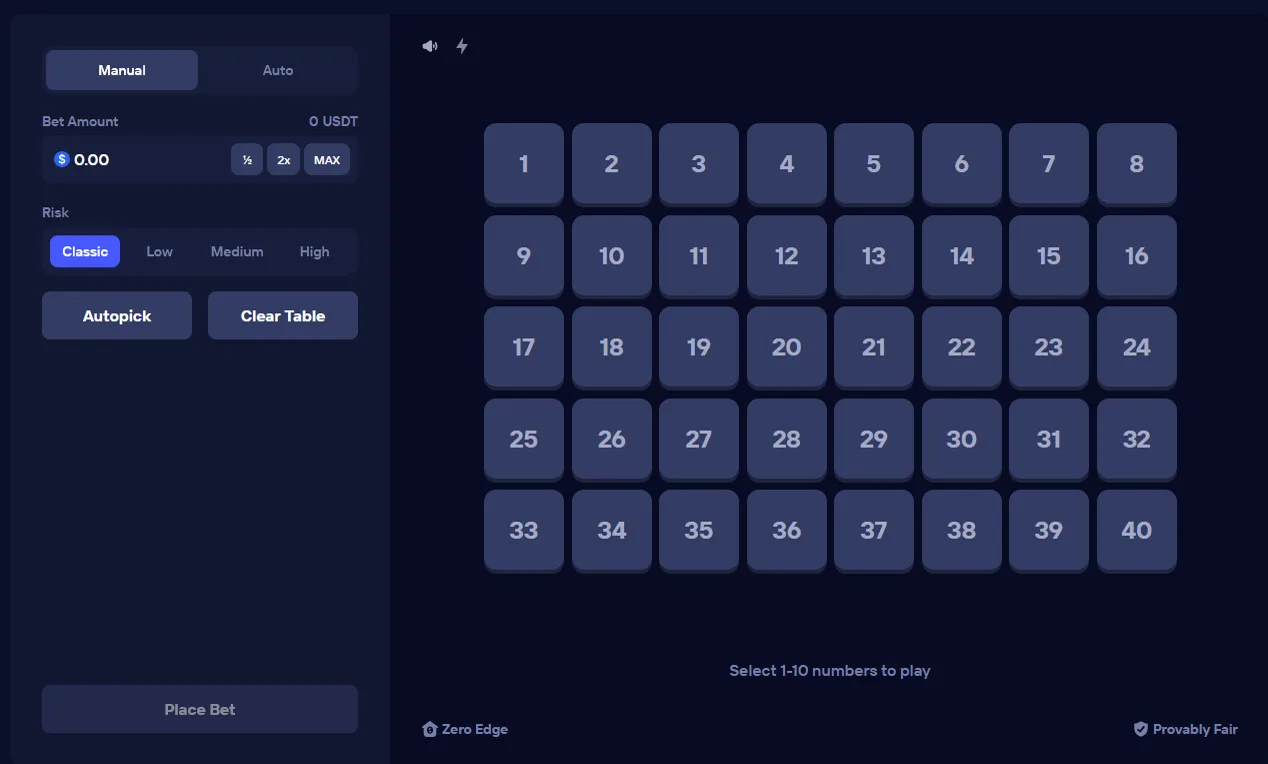
How the odds work
Forty numbers on the board, a fixed set drawn each round, and your picks either match or they do not. That is a hypergeometric draw — sampling without replacement — and the chance of hitting exactly h of your k picks follows directly from it.
The counter-intuitive part: picking more numbers does not improve your odds. It changes the distribution of how many you hit, and the paytable is adjusted to match. Ten picks means more hits on average and a correspondingly smaller payout per hit.
Five picks
| Hits | Chance | Roughly |
|---|---|---|
| 0 | 21.6572% | 1 in 5 |
| 1 | 41.6484% | 1 in 2 |
| 2 | 27.7656% | 1 in 4 |
| 3 | 7.9330% | 1 in 13 |
| 4 | 0.9574% | 1 in 104 |
| 5 | 0.0383% | 1 in 2,611 |
Hitting all five is a 0.0383% event — roughly one round in 2,600. Hitting one or two is the overwhelmingly common outcome, at close to seventy percent combined.
Ten picks
| Hits | Chance | Roughly |
|---|---|---|
| 0 | 3.5445% | 1 in 28 |
| 1 | 16.8784% | 1 in 6 |
| 2 | 31.0716% | 1 in 3 |
| 3 | 28.8200% | 1 in 3 |
| 4 | 14.7102% | 1 in 7 |
| 5 | 4.2365% | 1 in 24 |
| 6 | 0.6789% | 1 in 147 |
| 7 | 0.0575% | 1 in 1,739 |
Two or three hits covers sixty percent of rounds. Seven hits is roughly one round in 1,700, and the tail beyond that is thin enough that a paytable can afford to advertise very large multipliers there without exposure.
These are the draw probabilities, not the return. Turning them into an RTP figure needs the paytable — how much each hit count pays at each risk level — and that did not fit in the screenshot we were working from. It goes here once we have it rather than being estimated.
What the risk levels do
Classic, Low, Medium and High do not change the draw. The board is the same, the probabilities above are the same. What changes is how the paytable distributes the return across hit counts.
Low risk pays something for common outcomes and little for rare ones. High risk pays nothing until you hit several and then pays heavily. The expected return is broadly the same across all four — the setting is a choice about variance, which is the same pattern that runs through Plinko and Limbo.
The pattern-picking problem
Keno boards invite systems: hot numbers, cold numbers, diagonals, birthdays. None of it does anything. Each round is an independent draw and the board has no memory, so any set of picks has identical odds to any other set of the same size.
Which is the useful thing to know about Keno: the only decision that affects your result is how many numbers you pick and at what risk level, and neither of those changes what the game costs you.
Every draw is verifiable afterwards with the seed checker.
The board has no memory
Any ten numbers are as good as any other ten. Pick fast and check the paytable instead.
Play at Duel